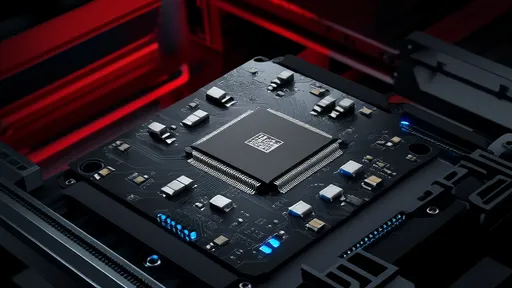
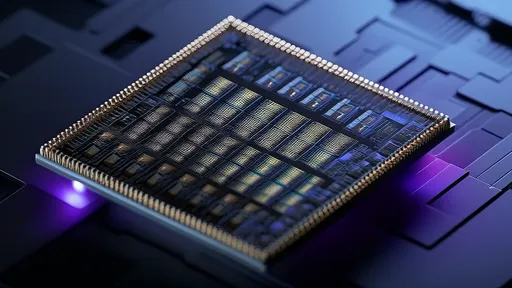
The semiconductor industry is undergoing a quiet revolution as edge AI chips embrace sparse computing optimization to tackle the growing demands of real-time machine learning. Unlike traditional approaches that process all data uniformly, sparse computing selectively ignores non-critical operations, unlocking unprecedented efficiency gains. This paradigm shift is reshaping how we design hardware for an era where latency and power constraints dominate.
Sparse computing isn't merely an optimization technique—it's a fundamental rethinking of computational logic. Modern neural networks exhibit remarkable redundancy, with many activations remaining zero during inference. Conventional processors waste cycles processing these null operations, but next-generation AI chips are learning to skip them entirely. Companies like Rain Neuromorphics and Syntiant are pioneering event-based architectures where computation only occurs when meaningful data transitions happen.
The implications extend beyond power savings. By focusing computational resources where they matter most, sparse processors achieve sub-millisecond latency crucial for applications like industrial predictive maintenance. A robotic arm monitoring vibration patterns can now process sensor data locally while consuming less power than a household light bulb. This combination of responsiveness and efficiency was unimaginable with traditional dense computing approaches.
Memory bandwidth represents the silent killer in edge AI performance, and sparse computing delivers perhaps its most dramatic impact here. Typical convolutional neural networks might require moving hundreds of megabytes of weights for simple image recognition. Sparse architectures employing weight pruning and activation sparsity can reduce this data movement by 10-20x. Startups like DeepAI Semiconductor report 4-8x improvements in effective memory throughput through their sparse tensor accelerators.
Implementing sparse computing introduces fascinating engineering challenges. Dynamic sparsity—where zero patterns change with each input—requires hardware that can adapt in real-time. Some solutions employ metadata tagging to identify sparse patterns, while others use predictive methods to anticipate which computations can be skipped. The most advanced chips now feature sparsity-aware schedulers that reconfigure compute pipelines on the fly.
The software ecosystem plays catch-up as hardware advances. Traditional AI frameworks weren't designed to expose or exploit sparsity. New compilation tools are emerging that can analyze neural networks and automatically generate sparse-optimized code. Google's Sparsetral and NVIDIA's CuSPARSE libraries demonstrate how software can transform conventional models into sparse-friendly formats without sacrificing accuracy.
Real-world deployments reveal sparse computing's transformative potential. In automotive applications, sparse-enabled chips process LiDAR data while consuming 60% less power than previous generations. Medical edge devices can now run complex anomaly detection algorithms continuously without thermal throttling. Even consumer electronics benefit—smartphone cameras employing sparse AI chips achieve professional-grade computational photography with negligible battery impact.
The environmental implications shouldn't be overlooked. Data centers already consume 2% of global electricity, and edge devices add substantially to this footprint. Sparse computing could reduce AI's energy demand by orders of magnitude as it proliferates. Researchers at MIT estimate that widespread adoption might prevent 50 million tons of CO2 emissions annually by 2030 simply through reduced computation waste.
Looking ahead, sparse computing will likely converge with other revolutionary approaches like in-memory computing and analog AI. The most advanced research chips now combine all three paradigms, achieving energy efficiencies approaching biological neurons. While challenges remain in standardization and tooling maturation, the industry appears committed to making sparse computing the new baseline for edge AI hardware.
This technological shift carries profound implications for product designers and system architects. The old metrics of TOPS (Tera Operations Per Second) become increasingly irrelevant in a world where smart operation skipping matters more than brute-force computation. Tomorrow's most successful edge AI products won't be those with the highest peak performance, but those that most intelligently avoid unnecessary work.

By /Jul 22, 2025

By /Jul 22, 2025
By /Jul 22, 2025

By /Jul 22, 2025

By /Jul 22, 2025

By /Jul 22, 2025

By /Jul 22, 2025
By /Jul 22, 2025
By /Jul 22, 2025

By /Jul 22, 2025
By /Jul 22, 2025

By /Jul 22, 2025

By /Jul 22, 2025

By /Jul 22, 2025

By /Jul 22, 2025

By /Jul 22, 2025

By /Jul 22, 2025

By /Jul 22, 2025
